Slow Swing Speed? 3 Golf Clubs Design Secrets for More Distance

Have you also experienced this kind of frustration? On the tee box, you twist your body with all your might, feeling like you’ve used every ounce of strength you have, yet the little white ball seems as if something is tugging at its tail. It lazily floats out, landing dozens of yards short of your expected target.
You look at the partner beside you, who appears to be swinging with hardly any effort, and yet his ball flies effortlessly much farther. You begin to doubt yourself: Is my strength not enough? Or is there something fundamentally wrong with my technique?
Let me tell you a truth that is often overlooked: the problem may not be entirely in your body or your swing. Sometimes, your equipment, especially your golf club, may be quietly “holding you back.”
For players whose swing speed is not inherently fast, choosing a club that amplifies your energy rather than consumes it is the most direct and effective shortcut to gaining distance.
Today, we won’t talk about complex biomechanics. Instead, we will focus solely on three hidden design secrets within the golf club itself. They are like “legal cheat codes” prepared just for you, helping you squeeze out more precious yards from your existing swing.
Secret One: Where Did the Weight Go? Lightweight Design Is a Revolution in Efficiency

Let’s start from the most fundamental principle of physics: distance comes from clubhead speed, and clubhead speed comes from how efficiently you can swing the entire golf club.
If most of your effort is spent moving a heavy shaft, then the energy transmitted to the clubhead, and ultimately to the ball, will be very limited.
Imagine driving a nail with a heavy hammer versus one that is well-designed and perfectly balanced. Which one is easier to accelerate and delivers a more powerful strike? The answer is obvious.
Traditional thinking believes that “heavier means more stable,” but for players with limited swing speed, excessive total weight is more like sandbags tied to your wrists. It slows your tempo and forces you to overuse your upper body to start the downswing, disrupting balance and timing.
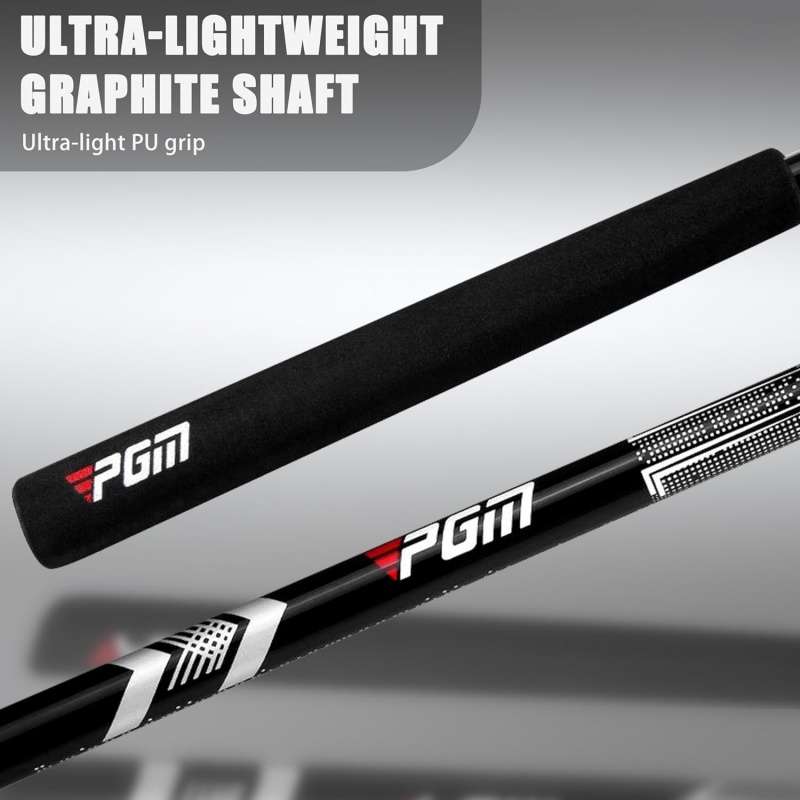
This is the core logic behind the widespread adoption of lightweight carbon fiber shafts in modern golf club design. The goal of this material is not to make the club feel “floaty,” but to carry out a thorough “weight redistribution revolution.”
By using carbon fiber, manufacturers can significantly reduce unnecessary shaft weight and reallocate the saved weight to places that truly enhance performance.
These areas include optimizing the clubhead’s center of gravity or balancing the grip end, thereby creating a swing weight that is easier to accelerate. The significance of a lightweight-designed golf club lies in allowing you to more easily reach, or even exceed, your natural maximum swing speed.
You no longer have to fight against weight. You can focus more on tempo and release.
When your swing becomes smooth and effortless, you can strike the ball more consistently on the sweet spot, which is the first and most important foundation for increasing driving distance.
Secret Two: The “Spring Effect” of the Clubhead: How Materials Translate into Distance
Now, let’s assume you have already transferred speed to the clubhead more efficiently through a lightweight shaft. Next comes the moment of impact between the clubhead and the ball, where the second secret takes effect.
You can think of it as the clubface’s “spring effect,” or energy transfer efficiency.
Different clubhead materials respond differently when struck. For distance-focused woods, especially drivers and fairway woods, the goal is to allow the clubface, within the limits of the rules, to undergo subtle elastic deformation at impact and then rebound more kinetic energy back to the ball, rather than dissipating it through vibration.
This is why you often see golf clubs designed for distance paying special attention to clubhead materials. For example, using precision aluminum alloy clubheads is a classic solution.
- They maintain sufficient strength and durability.
- They provide excellent overall rebound performance.
- They promote efficient and solid energy transfer at impact.
When the ball strikes the face, this material helps create a feeling that the clubface is “launching” the ball rather than simply “pushing” it forward.
This optimized energy transfer directly affects initial ball speed. Even with the same swing speed, a higher launch speed means the ball will fly farther.
Therefore, when choosing a golf club, paying attention to the material technology of the clubhead is essentially judging whether it is an efficient “energy converter” that can truly turn your swing effort into longer drives.
Secret Three: The “Sweet Spot” of Flex, Finding the Perfect Bridge for Power Release

Now we arrive at the bridge that connects you to the clubhead: shaft flex. This is the most confusing factor, yet one with an enormous impact on distance.
Many people mistakenly believe, “I’m not very strong, and my swing speed is slow, so I should use a softer shaft, like L or A flex, to help ‘launch’ the ball.” This is actually a common misconception.
Shaft flex is essentially about controlling torque and timing of bending.
A shaft that is too soft for your swing speed is like an overly elastic suspension bridge.
- It bends and stores energy too early during the downswing.
- At impact, it may still be rebounding and twisting aggressively.
- This leads to unstable clubface angles, often over-closing.
The result is loss of power and directional control. The ball may fly high but not far, and often with a leftward curve.
On the other hand, a shaft that is too stiff is like an iron bridge. It barely bends and requires very high swing speed and strength to activate.
If you cannot properly load it, the club feels like swinging a steel rod. You lose the sense of the clubhead, cannot store or release elastic energy, and the strike feels harsh, with distance suffering as well.
For the vast majority of amateur golfers with average swing speeds, R (Regular) flex is often that “sweet spot.”
It is designed to strike an ideal balance between control and power release.
An R-flex shaft provides timely bending and recovery for moderate swing speeds, helping you load energy correctly and release it efficiently at impact while maintaining sufficient stability.
Choosing a golf club with properly matched flex means building a bridge that is both strong and responsive, allowing the power generated by your body to be delivered to the ball accurately and on time.
It creates a feeling of working together, rather than you and the club fighting separate battles.
Frequently Asked Questions (FAQ)
Q: Should I deliberately choose a softer shaft than what I currently use to pursue more distance?
A: Not necessarily, and it may even backfire. As explained above, a shaft that is too soft can lead to loss of control and efficiency.
A more scientific approach is to start with R (Regular) flex, the most universally suitable option. If professional testing shows your swing speed is significantly below average, then consider softer options.
For most players who simply feel their swing is “slow,” R flex combined with a lightweight overall design often delivers a noticeable distance increase.
Q: Will lightweight clubs feel too “floaty” or insubstantial at impact, making me afraid to swing freely?
A: This is a very valid concern, but modern high-quality lightweight designs have already addressed this issue. The key lies in swing weight balance.
A good lightweight golf club does not simply remove weight everywhere; it redistributes weight intelligently.
You may feel the swing is easier overall, but at impact, thanks to the optimized center-of-gravity design, you still receive solid and stable feedback. In fact, because your swing speed increases, the impact can feel even more powerful and satisfying.
Conclusion: Let Your Equipment Be an Ally, Not a Burden
Increasing driving distance does not always mean grinding in the gym or completely rebuilding your swing. Often, it is a game of efficiency.
If your swing speed is not power-based, your golf club should play the role of a helper.
Let’s review these three secrets:
| Design Element | Core Benefit |
|---|---|
| Lightweight carbon fiber shaft | Reduces burden and improves swing speed efficiency |
| Well-designed aluminum alloy clubhead | Ensures solid and efficient energy transfer |
| Proper R flex | Allows smooth, controlled release of power |
It’s time to re-evaluate the weapon in your hands, especially your driver, the club that most affects distance. Does it have these “cheating” design traits built in?
If you want to explore whether your current equipment truly matches your swing, get a professional club fitting and equipment evaluation.
A smart equipment upgrade often produces immediate results. When you discover that the ball flies farther without extra effort, what you gain is not just numbers on a distance chart but tremendous confidence throughout your entire game.
Don’t let your club become the ceiling of your potential. Let it be the starting point for breaking through.