From Range to First Tee: How to Build Complete Trust in a New Club

We’ve all experienced that thrilling moment: a brand-new golf club finally arrives. You rush to the practice range and take it out on the mat. After a few swings, a smile spreads across your face—it feels perfect!
The ball flies straight and far; the feel is solid. You leave confident, ready to conquer the course.
Then, game day arrives. You stand on the first tee with the same golf club in hand, but it feels completely different. That smooth trust from the range is gone, replaced by subtle hesitation.
You overthink: “Is my grip correct? My stance? Will I hit it straight?” The result: a tentative swing and a ball veering into the trees. This is the classic “practice range hero, course nervous wreck” syndrome.
The problem isn’t the club, nor entirely your technique. It’s a lack of trust. Initial comfort in a stress-free environment isn’t enough to withstand course pressure, tension, and countless variables.
Transforming a new golf club from “kind of liked” to “absolutely trusted weapon” requires a conscious, strategic process.
Today, we’ll explore how to safely transfer your range feel to the first tee and make your new club your most reliable ally.
Step One: Purposeful Practice, Not Mindless Hitting

Banging endless balls on a wide range, beyond venting and muscle training, does little to build trust. Trust begins with conscious communication. You need to understand your new partner’s “personality” and capabilities in various scenarios.
Don’t just hit one ball after another. Set specific tasks for your practice:
- Test trajectory control: Try hitting a slight draw, then a slight fade. How does the golf club respond? What swing adjustments are needed?
- Explore distance segments: Hit balls at 80%, 90%, and full power to observe distance and trajectory changes. Understand its “cruise” and “full-speed” modes.
- Simulate different lies: For a wood or hybrid, tee the ball lower to simulate windy, low-trajectory shots. For irons, place the ball slightly forward or back to test forgiveness.
- Club transition practice: If you have a full new iron set, don’t just hit the 7-iron. Hit from short irons to long irons, feeling the weight transition and distance progression.
This purposeful practice is like a deep conversation with your golf club. You ask questions (“Can you hit a high shot?”), and it answers with flight and feel.
Each piece of clear feedback is a deposit in your trust account. Knowing its boundaries and capabilities prevents fear of the unknown on the course.
Step Two: Create “Pressure” Simulation
The range lacks real consequences. Miss? No problem, grab another ball. On the course, every shot affects score, money (if small wagers), and pride.
To bridge this gap, artificially introduce pressure during practice.
- Set consecutive success goals: e.g., “Before leaving the practice green with this new putter, I must sink 10 consecutive 6-foot putts.” Miss the 9th? Reset the count. This simulates course putting pressure.
- First tee simulation: On the range, use only one ball. Imagine standing on your most feared tee with water hazards. Hit that one ball with your new driver and accept the result before moving to the next shot. Treat every swing seriously.
- Must-complete tasks: e.g., “With this new hybrid, I must hit the next five balls within 10 yards of the 150-yard marker.” This simulates precision pressure approaching the green.
The core is shifting focus from mechanics to execution results. Trust builds when you concentrate on goals and let your body and equipment automatically perform.
Repeated success under micro-pressure conditions trains your subconscious to believe, “This golf club can do it.”
Step Three: Use Club Design Features for “Trust Training”

Modern clubs are designed to enhance performance and confidence. But if unused consciously, they are just theory.
Top trust training actively delegates trust to the club’s technology, especially in high-doubt moments like putting.
Example: Putting
Putting trust crises are critical because it’s purely a mental and feel game. A well-designed putter serves as an extension of your nervous system.
Training One: Delegate alignment to design
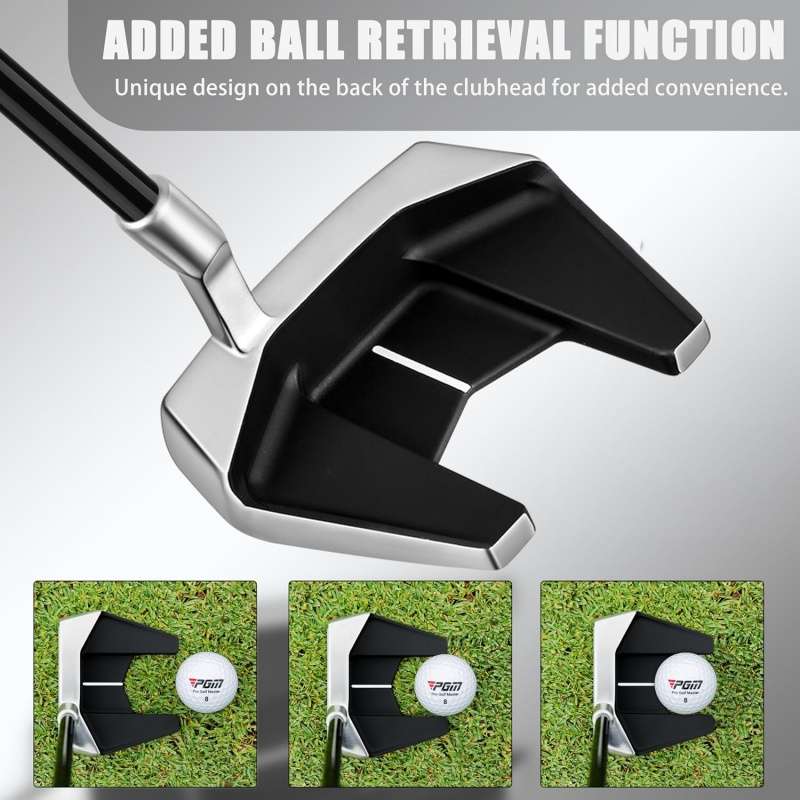
Many putters feature precise alignment aids. For instance, a putter with a clear white line answers the question, “Am I lined up?”
Practice deliberately using the line to align, then fully trust it for your stroke. Even with inner doubts, focus on rhythm and distance, not overchecking. Repeatedly trusting the reference system stabilizes putting dramatically.
Training Two: Delegate stability to structure
A low-center-of-gravity design, via perimeter weighting or sole channels, reduces twisting during the stroke.
Try “eyes-closed putting” at short distances (3–5 ft). After aligning with the line, close your eyes and putt. Your brain relinquishes visual control, relying on muscle memory and the putter’s inherent stability. Success builds deep trust in the putter’s steadiness.
The essence: consciously let go. You stop micro-managing and allow the golf club’s design to do its job.
You transform from operator to conductor working with an efficient tool—critical for unshakable trust.
FAQ
Q: How long does it take to fully trust a new golf club? Should I bring it to the course immediately?
A: Time varies by person but depends more on the quality of “trust-building” practice than hours.
Recommended: at least 2–3 targeted practice sessions on the range/green before official play. The key is quality. When you can execute preset tasks under micro-pressure, you’re ready to take it to the course. Full trust is gradual, typically consolidated over 3–5 rounds.
Q: If the first few holes with the new golf club go poorly, what should I do? Switch back or stick with it?
A: Crucial psychological point. Pre-round plan: “The front nine is for learning and adjustment; the score is secondary.”
When mistakes occur:
- Avoid major technical changes: Two bad balls don’t mean the golf club is wrong—don’t overadjust.
- Return to simple feel: Recall your best practice swing. Focus on reproducing that holistic feeling, not micro-technical details.
- Stick it out: Unless the club causes discomfort or is fundamentally mismatched (length, specs), complete the round. Switching mid-round reinforces the “new club fails” mindset. The learning curve unfolds, usually revealing true value in later holes as swings become instinctive.
Conclusion: From Transaction to Partnership
Buying a new golf club is a one-time transaction. Making it an indispensable part of your bag requires time, thought, and strategic practice to cultivate a deep partnership.
The process isn’t magic; it’s methodical: understand it through purposeful dialogue, test it under pressure, and finally, learn to rely on its intrinsic design intelligence.
On the course, when you no longer think about the club itself but focus entirely on strategy, goals, and swing rhythm—you know trust is established.
Give your new weapon patience, and give yourself a strategy to guide it. Don’t just take it out of the box and throw it into battle. Learn it, challenge it, and finally, truly trust it. When that day comes, the steps from the practice range to the first tee will be confident and smooth. What you hold in your hands will no longer be a stranger but a tested, reliable companion.