Information Overload? A Minimalist Club Selection Guide for Golf Beginners

Welcome to the world of golf! You’ve just fallen in love with the game, visited the driving range a few times, and even mustered the courage to finish your first 9 holes. Now, you realize you need your own set of golf clubs.
Excitedly, you start searching—“best beginner golf clubs,” “how to choose golf equipment”—and suddenly, you are overwhelmed.
Carbon fiber vs stainless steel? Loft, spin, MOI (moment of inertia)—what does it all mean? Those sleek blade irons that professionals use look amazing; should you get them too? Your cart has multiple 7-irons, your browser has a dozen review tabs open, and yet you are more confused than ever. Friend, I understand. You are experiencing typical beginner information overload.
Don’t worry. Golf is already challenging—don’t make equipment selection harder. Before you become an equipment expert, just remember this minimalist
“pitfall avoidance guide”
. Avoiding these common mistakes will make your starting path immediately clearer and smoother. The goal is not to find the “theoretically best” club, but the most
beginner-friendly, reliable partner
.
Pitfall 1: Blindly Buying Professional Player’s Golf Clubs
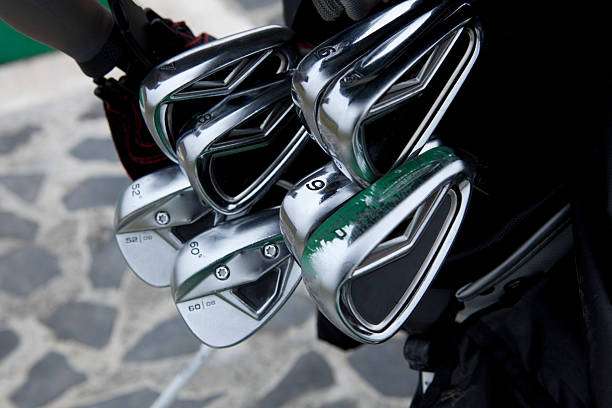
Let’s expose the most glamorous and enticing trap. You watch professionals swing effortlessly on TV with a club that looks elegant and precise, hitting incredible shots. A voice whispers, “If they can play so well with this, it must be the best golf club in the world. I need the same one!”
Stop immediately. For beginners, this is almost the worst possible equipment decision.
Professional golf clubs (often called “player’s” or “blade” clubs) are designed for entirely different needs:
|
Professional Needs |
Impact on Beginners |
|
Extreme feedback and control: Professionals have highly repeatable swings, hitting the sweet spot almost every time. Clubs provide precise vibration feedback for minute adjustments. | Low forgiveness: Sweet spots are tiny, and weight distribution is for feel, not help. Even slight off-center hits result in harsh feedback and loss of speed and direction—shots become short and off-target. |
It’s like a beginner jumping straight into an F1 car. Theoretically the fastest, but practically uncontrollable—any small mistake can lead to disaster.
What should you look for? Seek golf clubs labeled “game improvement” or high forgiveness. Characteristics typically include:
- Larger, thicker heads;
- Wider soles;
- Cavity-back design spreading weight around.
The purpose: help you when shots aren’t perfect. Edge hits still travel well, maintaining flight and speed. Remember, as a beginner, your friend is
forgiveness
, not harshness.
Pitfall 2: Obsessing Over Individual Club “Perfection” and Ignoring System Cohesion
After avoiding the first pitfall, you might think, “Okay, no pro golf clubs. But I need the perfect version of every single club!” So you compare Brand A’s 7-iron with Brand B’s, analyzing tiny technological differences or a 2-yard advantage.
For your first set, this is time-consuming and inefficient. Why?
A golf set isn’t 14 independent weapons—it’s a
system
. Each club’s length, weight, swing weight, and even aesthetics should transition smoothly. Switching golf clubs should feel consistent, helping you build muscle memory.
Mixing brands—a driver from Brand A, a hybrid from Brand B, second-hand irons from Brand C, and a putter from Brand D—often results in a “disjointed army.” Balance points, shaft feedback, and grip thickness vary, forcing your body to readapt every swing, increasing difficulty and inconsistency.
The smarter path: Start with a complete, beginner-friendly golf set. A well-designed entry- or mid-level set is valuable because of its
systematic integrity
.
|
Feature |
Benefit |
|
Unified performance philosophy | Lightweight graphite shafts across the set for consistent swing feel, easier rhythm, and less fatigue. |
|
High forgiveness design | Large driver heads, cavity-back irons, and low-CG putters help beginners recover from imperfect shots. |
|
Seamless distance progression | The set sequence covers all distances: driver, fairway woods, hybrids, and irons. No guesswork needed. |
Choosing a set lets you focus practice on
consistent swing mechanics
rather than adapting to different equipment—a huge efficiency advantage.
Pitfall 3: Ignoring the Club Bag
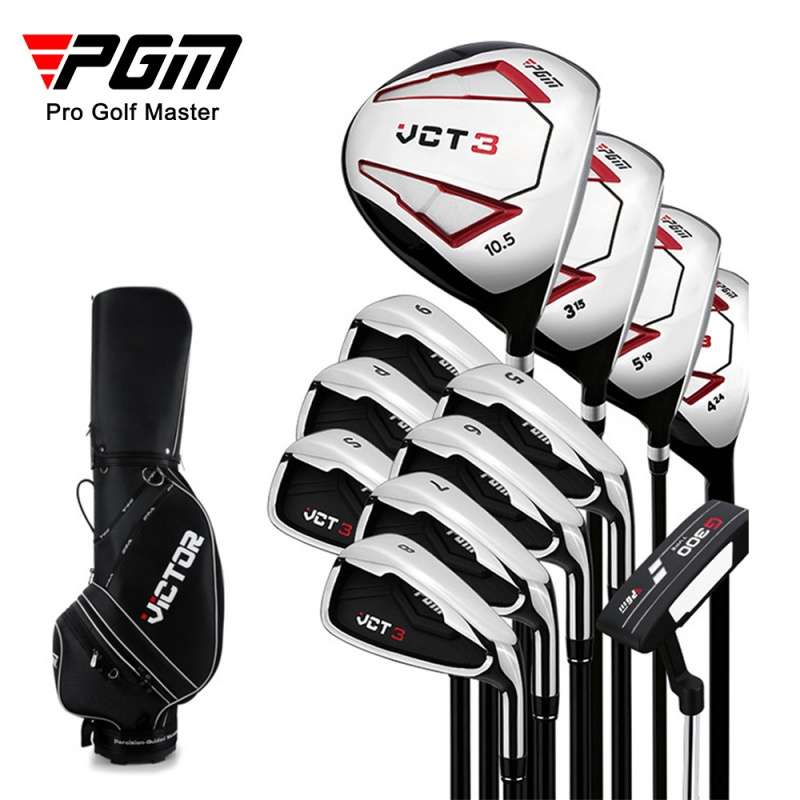
When buying individual golf clubs, beginners often overlook the golf bag. A poorly designed, low-quality bag can silently damage your carefully chosen (or future upgrade) clubs.
Cheap bags may lack protective dividers, causing clubs to collide and scratch carbon fiber shafts. Poor strap systems lead to sore shoulders after 9 holes. Unstable stands wobble or collapse.
A high-quality stand bag is the
silent guardian
of your equipment. Good beginner sets usually include a bag matching golf club quality: full head covers, ergonomic straps, a stable pop-up stand, and well-planned pockets for balls, tees, gloves, and drinks.
This isn’t a mere “bonus gift”—it’s essential to a complete playing experience, protecting investment and increasing comfort and professionalism. Always consider the bag when evaluating a set’s value.
FAQ
Q: Should I buy a brand-new set or second-hand as a beginner?
- New set: Immediate, complete, worry-free. Matched system, new grips, full warranty, pristine condition. Focus entirely on swing learning.
- Second-hand: High value, especially older, well-reviewed “game improvement” sets. Check grooves, shaft condition, and grip integrity. Great for budget-conscious beginners willing to hunt for quality.
Q: Do I need 14 clubs from the start?
Not at all! Rules allow up to 14, but you don’t need to carry them all. A 10–12 club beginner set (driver, 3/5-wood, hybrid, 6–7 irons, wedge, putter) suffices for years.
Empty slots can later accommodate specialty clubs like a 60-degree wedge or extra hybrid. Starting small helps learn each club’s purpose and distance.
Conclusion: Simplify Decisions, Focus on Swing

Dear beginner, golf is a lifelong journey. Early on,
simplify complexity
Equipment selection should not block enjoyment.
Resist flashy pro-club temptation, set aside obsession over single-club specs, and value system cohesion. A beginner-friendly, high-forgiveness, complete, lightweight set is the safest, smartest way to focus on growth.
It won’t swing for you, but it will amplify progress, forgive mistakes, and accompany your journey from clumsy to fluid.
Your priority: fall in love with the feel of club and body as one, the ball tracing its flight, and the tranquility of walking the greens—not getting trapped in spec comparisons.
Take a deep breath, simplify your choices. Find the set that gives you confidence on the tee and courage at each shot, and then enjoy your own golf story. Your adventure is about to truly begin.